


Tai Po will return to the Premier League next season with a young squad and a top-table finish in the First Division. Club secretary Chan Ping and chairman Peter Lam explain why they felt it would be a “missed opportunity” not to promote.
After HKFA chairman Pui Kwan-kay let slip that the Premier League intended to expand back to ten teams next season, rumours immediately began trickling that Tai Po and Sham Shui Po were the two clubs who intended to apply for promotion into the top flight. It is no secret that the HKFA needs the top flight to expand in order to maximize their AFC Champions League slot allocation for 2023-24, but also to try and increase professional opportunities for local footballers.
A ten-team league appears to be the maximum that Hong Kong can handle without diluting an already limited talent pool, despite the chairman’s insistence that the HKFA hopes to have 12 teams in the long term.
When asked directly about the rumours by RTHK, Tai Po chairman Peter Lam stated unequivocally that the club were “very interested” in promotion and that he, along with general secretary Chan Ping, were “vigorously preparing” to spend next season in the Premier League.
The news that the Greens are returning two years after self-relegating to the First Division due to financial difficulties is a boon for the HKFA, which needed to hastily establish a U23 team in the Premier League to make up the numbers this season. However, the decision to promote was not made in the spur of the moment, but one that was taken in consideration of this season’s results and the club’s purpose.
“There was no promotion and relegation this season (in the lower divisions) due to the pandemic. It would’ve been ideal to have gone up as champions, but nevertheless, the Premier League is looking to expand and we, along a number of other clubs, received an inquiry from the HKFA about promoting,” Chan said. “From my perspective, managing a team in the top flight requires much more work than staying in the lower divisions. Everyone in our industry understands the reality that unless the market is flourishing, it’s hard to run a professional club.
“Still, I referred (the HKFA’s inquiry) over to the chairman. After talking it over with some business partners, we all agreed that the youngsters had performed so well that it would be a wasted opportunity if we didn’t promote. Even if most of the majority of the squad will be young players, shouldn’t we give them that opportunity?”

Chan Ping said that Tai Po’s squad next season will mostly consist of young players. (Credit: inmediahk)
This year marks the 20th anniversary of the formation of district teams, a scheme which was initiated by the HKFA in 2002 to create representative teams in each of the 18 districts. Tai Po were one of 12 districts who participated in the inaugural Third District Division League, and as Chan is quick to remind fans, the Greens have won every virtually every domestic trophy available to them at least once over the past two decades. But, the secretary asserts that the club’s mission this time around is less focused on winning trophies.
“We want to provide more opportunities for our youngsters to develop. Simply put, we need to establish a platform for player development, otherwise there is no development,” he said, describing the difficulty of producing footballing talent in Hong Kong. “Our academy teams now consist of ten teams from the U8s to U23s, but the problem is that once a player reaches age 18, there is no further pathway for them. Players need to play real matches in addition to training. If they don’t play, then there is no way for them to improve their level.
“Granted, the lower divisions are a platform and yes, young players would still have a pathway to play professionally even if we aren’t part of the Premier League. But we’re talking about a platform at the highest echelon. It just means more to young players when they can represent their district in the Premier League.”
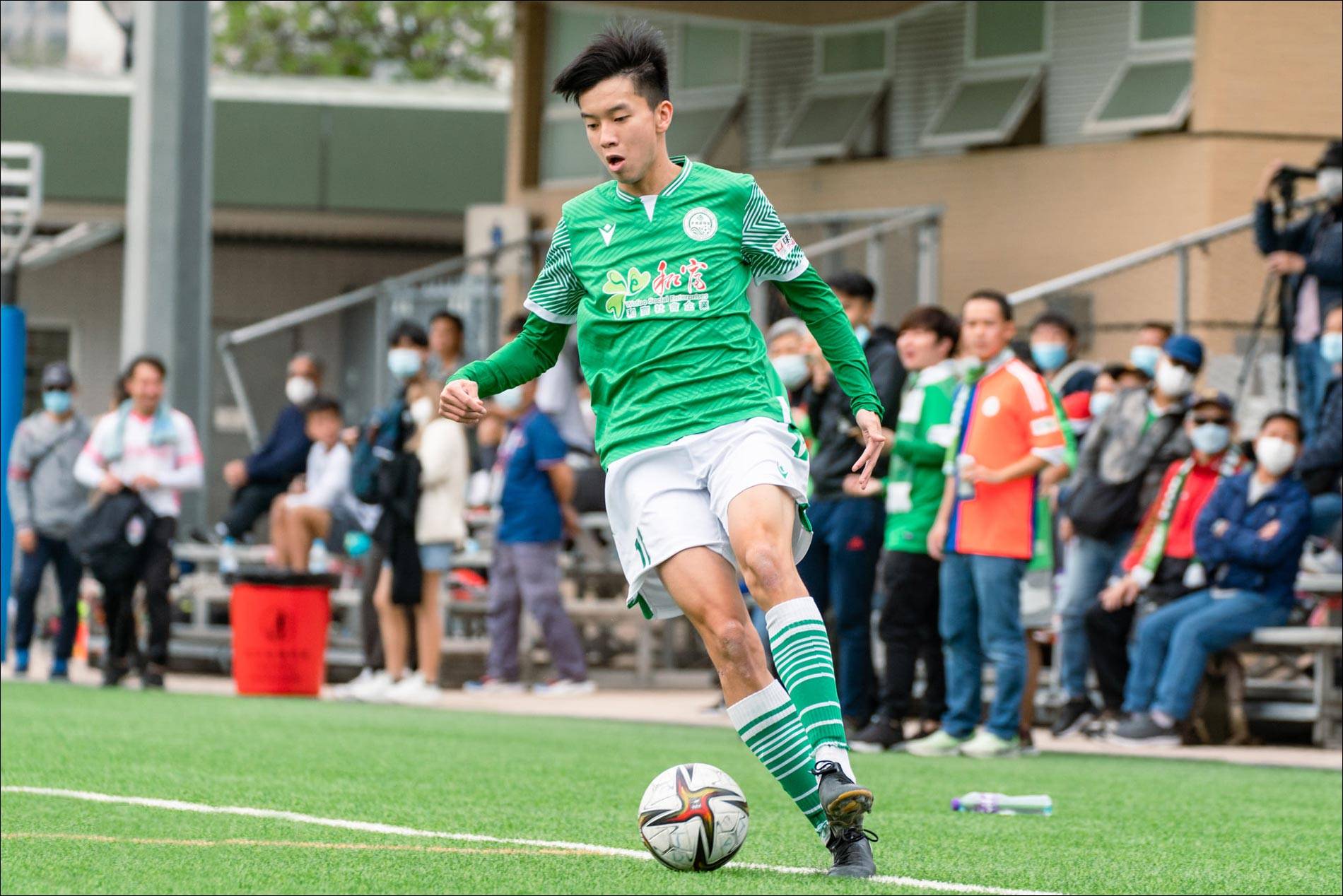
18-year-old winger Kwok Chun-nok has appeared in all 13 matches this season. (Credit: Tai Po)
Lam, who also serves on the Tai Po District Council and is the chairman of the Tai Po Rural Committee, said that while he was attending school in the UK, he witnessed first hand the bond that a community can have with their local club. “When I returned, I didn’t have any interest in running a club, although I retained an interest in football,” Lam admitted. “Slowly, I started to understand the landscape of local football a bit more and Chan Ping also invited me to come and watch Tai Po play. I studied up on the team and felt that there was something I could do to help local football improve.”
Although he is a public official, Lam says that more attention needs to be paid by the government to the club because of the ancillary benefits that the club provides to the community.
“We’re not in this to turn a profit. This is all about providing a contribution to Tai Po district, providing our players with an opportunity to raise their game, and to give them a sense of hope,” Lam relayed. “What’s important to remember is that our club consists of not only the first team, but another 20 teams (including the women’s teams) beneath them, which amounts to almost 500 academy players in our ranks. They’re all important to us and it’s crucial that we can also teach them life skills, such as having good manners, discipline, and teamwork. I want to see to it that Tai Po Football Club are able to teach these skills to (young people) from a young age.
“I hope that the government can pay more attention to us because we’re not looking at this from the standpoint of this upcoming election or the next election. We’re looking at the next ten years and how we can give more resources to kids right now to aid their development. When my son is a bit older, I’m going to sign him up for the Tai Po academy because I want him to learn soft skills like how to line up, which he won’t learn unless he is around other people.”

21-year-old attacking midfielder Hung Kin-yi has appeared in ten matches this season. (Credit: Tai Po)
The topic of money is unavoidable as the costs of running a club in the Premier League are vastly greater than that of an amateur club. This can also lead to financial ruin for the club if their sources of sponsorship become unstable, as Tai Po themselves experienced at the outset of the pandemic. The Greens’ main sponsor stopped funding the club in February 2020, leading to salary arrears for players and staff. The matter eventually required mediation by the Labour Department to resolve, but not before the lack of funds forced the club to withdrawal from the Premier League and self-relegate.
This time around, Chan claims that the Greens will be self-funded, using money from “people within the (Tai Po Sports Association) and the executive leadership” and $2 million in funding from the Home Affairs Bureau. The total budget for next season will be around $6-7 million for a squad that will be development focused.
The team will have almost assuredly have a different look to it next season as the average age of their starting eleven this season was 29.5. Older players who were starters this season, including the likes of Chris Annan, Aender and Li Hon-ho, are not expected to remain with the team. Chan stated that management would begin building next season’s squad after the First Division League Cup is over and added that several foreign players would be added to lead the youngsters. He confirmed that the club would need to recruit a new manager due to the fact that current head coach Chan Yuk-chi is a school teacher and would be unable to manage the team.
“Chan Ping and I laid out our objectives about what we wanted to achieve next season,” Lam explained. “We worked hard with our general manager to calculate what we could do with the money we had and how we could bridge the shortfall. In the end, it was difficult, but we got there and we hope that the players will work hard next season to achieve our objectives.”
Chan praised the chairman for his backing of the club and added that as a district team, it is not possible for the mission of the team to be the same as a traditional club.
“When you run a club, there are many different approaches that you can take,” he began. “For traditional clubs, like the South China’s, the Kitchee’s, or the Happy Valley’s of the world, their main objectives are to develop the best players possible, attract fans and win trophies. But, as a district team, our mission has to be broader. For example, when we report to the government each year, we need to demonstrate that we have participated in community activities and that our players have made a positive impact on society. All of these things are outside the bounds of sport.
“So, if you ask the chairman, ‘Why go through all this difficulty just to invest in local football?’ the answer is that he’s not only investing local football. He’s investing in a public good, no different from building infrastructure because this is his job as a public servant.”
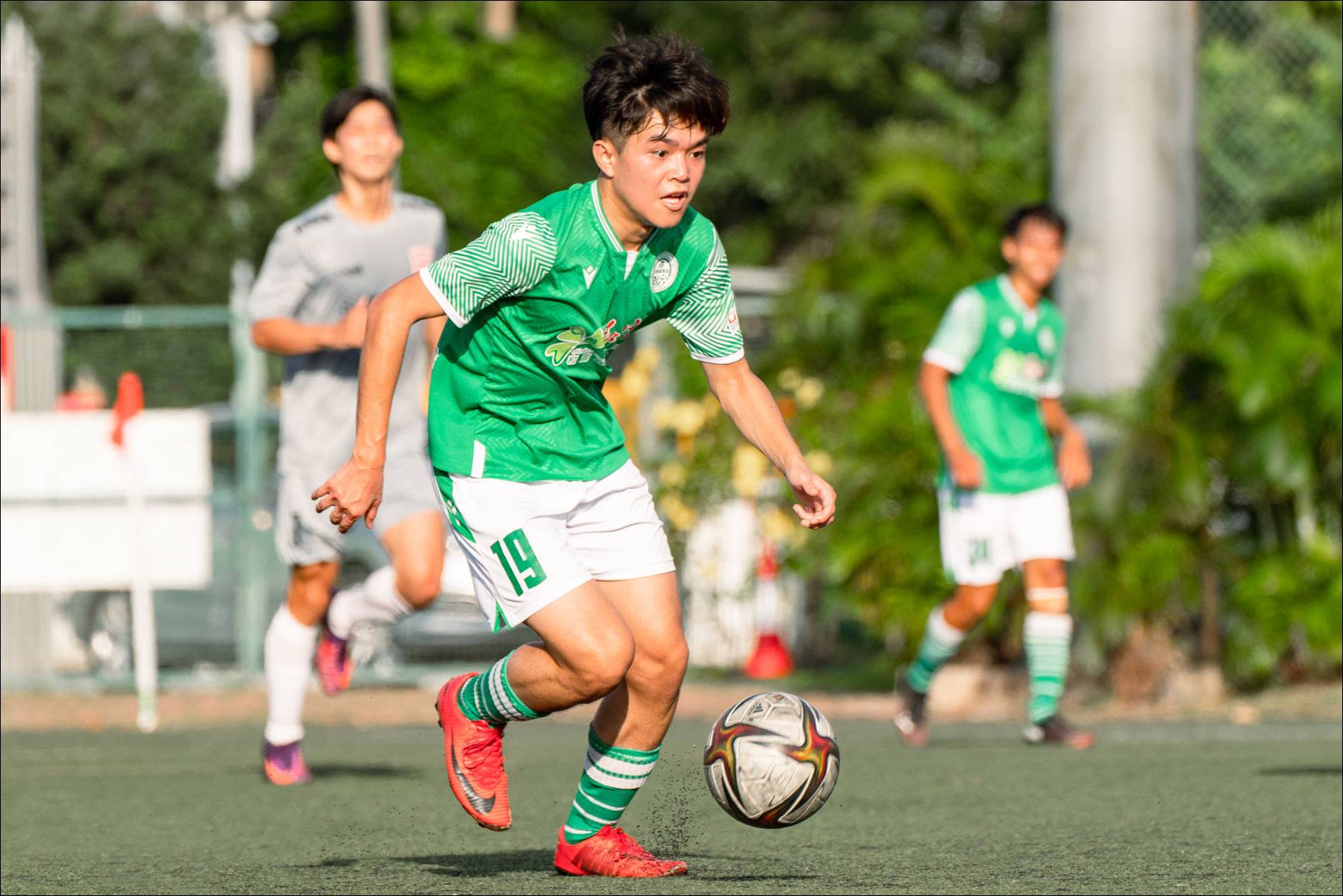
19-year-old right back Yip Ngai-san has appeared in seven matches this season. (Credit: Tai Po)
The two men were honest about needing to give Tai Po’s marketing efforts a jolt upon returning to the top flight. The Greens did very little social media last season after they were relegated, although they have been much more active this season.
“We need to boost our online presence. There’s more that we can do on that front and I plan to speak with my friends who work in marketing to discuss what we can do on that front. I hope that my colleagues on the district council and various other committees can attend more matches and support the team,” Lam said.
Chan agreed, and added, “Generally, if the club are playing well, the fans will turn up. So naturally, playing well is something we’ll expect from ourselves but we also need to leverage that fact that we represent a district. When most of our players come from the district, then of course, their parents will come and support us.
“We can also network with schools and grow our support through that means. Perhaps, we could hand out free tickets to elementary and high school students as not all of them come from socioeconomic backgrounds which can afford to watch football.
“All of this will cost money and this is another area where I hope the government are paying attention to what we’re doing and can lend us financial support.”