

João Emir has had one of the most complete careers in the often complicated world of domestic Hong Kong football. The affable and popular Brazilian, who lit up the midfield for all his teams with his creative play, has donned the shirts of the largest clubs in Hong Kong such as South China, Tai Po, Sun Pegasus and Eastern.
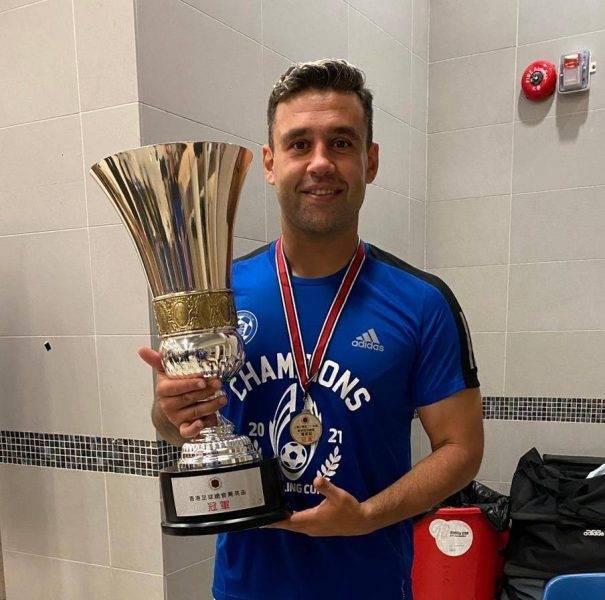
From his playing days, Emir created moments of magic that fans have long remembered. He won an impressive haul of trophies including the HK Premier League (Tai Po), two Fa Cups (Pegasus and Eastern), Sapling Cup (Pegasus) and the Senior Shield (South China).
Emir has now made the transition to becoming a coach and is passing on his well-earned knowledge and experience to a new generation.

In an exclusive interview, Emir details his long and winding journey from the second division in Brazil, via Ukraine, to joining the once storied giants, South China, in Hong Kong.
“I was playing in the Brazilian Second Division and there was one coach at the time who was also an assistant coach in South China. When I finished that season in Brazil, I got an invitation to play in Ukraine.
I went to Ukraine but there was a policy which said Under 22 players cannot be signed by the team. I was on the way back to Brazil when I was asked by the assistant coach ‘Do you want to come to Hong Kong?’
I told him I had never heard of this option though I was told that football was a little different in Hong Kong and I would sometimes be training in ‘public areas’ and that I was going to like it and that the club, South China, is very big.
I went back to Ukraine and I was ready to move again when I got loaned to South China and I ended I playing for six years. Unfortunately, I got injured and I had to leave again and then I came back and this was all handled by Mr Lo.
A lot of people helped me to adapt to Hong Kong and taught me the everyday basics such as where to shop for items.”
Emir has made Hong Kong his base and he still speaks fondly and openly about his transition to his new home over a decade ago. Emir adapted fast to all the cultural differences, particularly when it came to language.
“I came to Hong Kong in 2011 and I still remember everything from that day – December 27th 2011. I came with minimal English and I started to learn as I would watch TV in my language but put on the subtitles.
I also learnt Cantonese as 50 percent of the players (in the professional leagues) in Hong Kong do not speak English.

Emir with all his knowledge and experience of domestic football has a lot of insight into the game in Hong Kong and he is in a prime position to reflect on the evolution of game here.
Emir interestingly divides Hong Kong football into two periods, pre & post pandemic and he said there was a decline in the quality of football in Hong Kong post-COVID due to time being lost.
“I think football in Hong Kong can be divided into two parts. Pre-pandemic football in Hong Kong was growing very fast as there were quality local and foreign players. Everyone was looking to reach the highest point.

Post pandemic, with the economy changing, I saw that Hong Kong football, has been losing the quality, though it does seem to be improving again.”
Emir had the chance to experience the last true golden age of South China in the Hong Kong Premier League and he talked nostalgically about the significance of South China citing the club’s history and influence.
The HKPL has continued with the fallen giants though there are still a lot of fans who express regret over South China’s self-relegation for financial reasons.

“When I first came to Hong Kong, I read that South China had 40 something titles and hundreds of thousands of club members. When I came to Hong Kong, for the first six initial months, I began to understand how large South China actually was.
For me, it was very sad that South China did not stay in the premier league. We can also divide Hong Kong football in two parts in this sense, Hong Kong with South China in the HK Premier League and South China not in the HK Premier League and it is sad as they have such a long history.”
Thank You!